

The Tombstone Trio:
The Cowboys, the Gambler, and the Lawman...
❧
The first shot in the Tombstone Trio is fired seven months before four armed men walk down Fremont Street.
On the night of March 15, 1881, a Kinnear & Company stagecoach runs toward Benson through the darkness beyond Contention City. A voice calls for it to halt. Gunfire answers. Eli “Bud” Philpot is killed; passenger Peter Roerig is mortally wounded. Wells Fargo messenger Bob Paul, who had taken the reins that night, returns fire and drives the team clear.
The robbery does not end on that road. It draws Wyatt Earp and Ike Clanton into a secret arrangement to bring the suspects in, a bargain that later becomes one more source of mistrust, humiliation, and anger. By October, every grievance in Tombstone seems to be moving toward the same narrow vacant lot beside C.S. Fly’s boarding house.
Virgil, Morgan, Wyatt, and Doc Holliday come down Fremont Street. The Clantons, the McLaurys, and Billy Claiborne wait in the lot ahead. Only a few paces separate them. About thirty shots tear through the afternoon. When the smoke clears, Billy Clanton and both McLaurys are dead or dying. Virgil and Morgan Earp are wounded. Holliday is grazed. Wyatt stands untouched.
On the following afternoon, a brass band leads two hearses through streets crowded with mourners. Billy Clanton rides in the first; Tom and Frank McLaury lie together in the second. The procession moves toward Boothill while Tombstone watches from packed sidewalks.
The gunfight lasted about thirty seconds. The legend has been accumulating ever since.
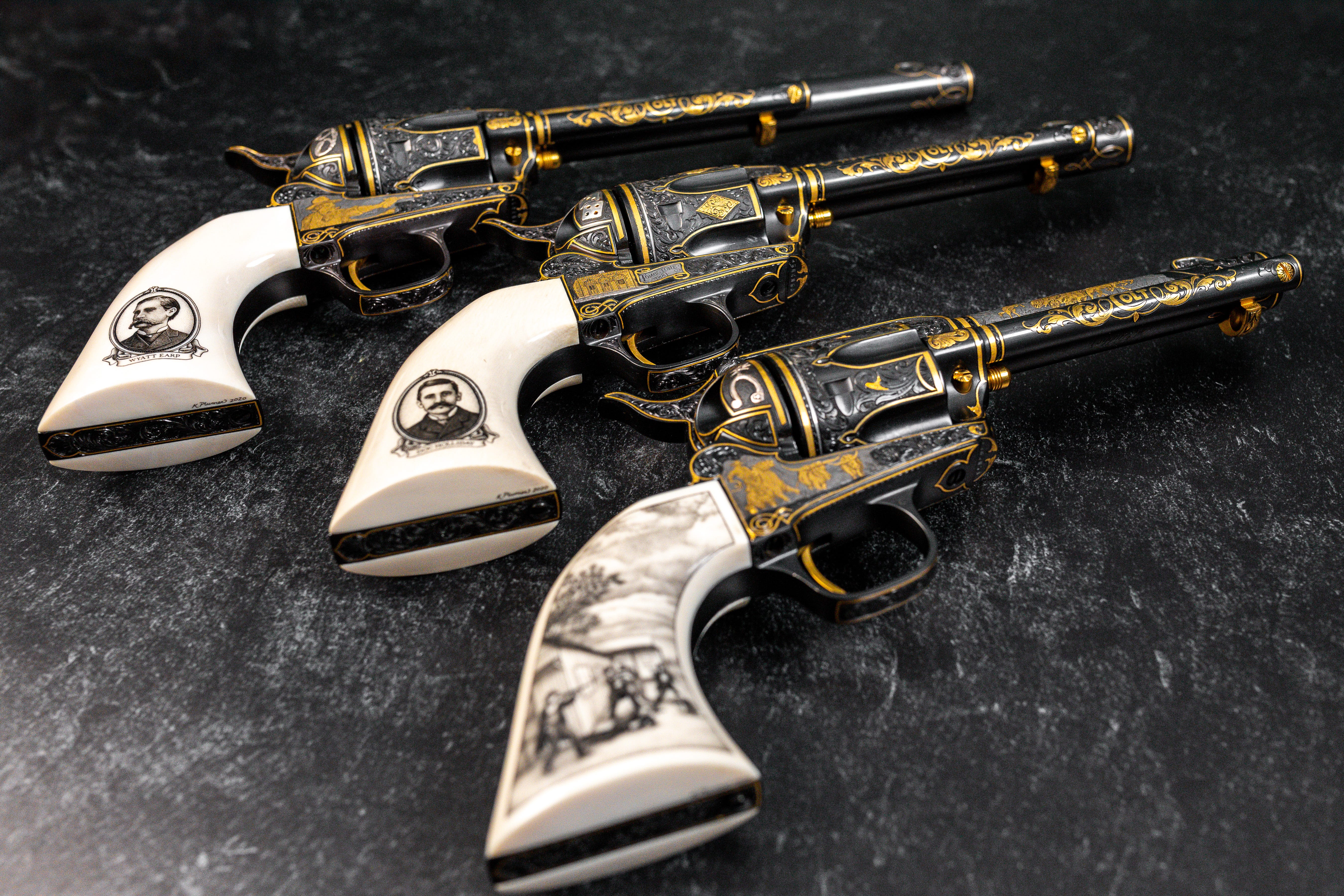
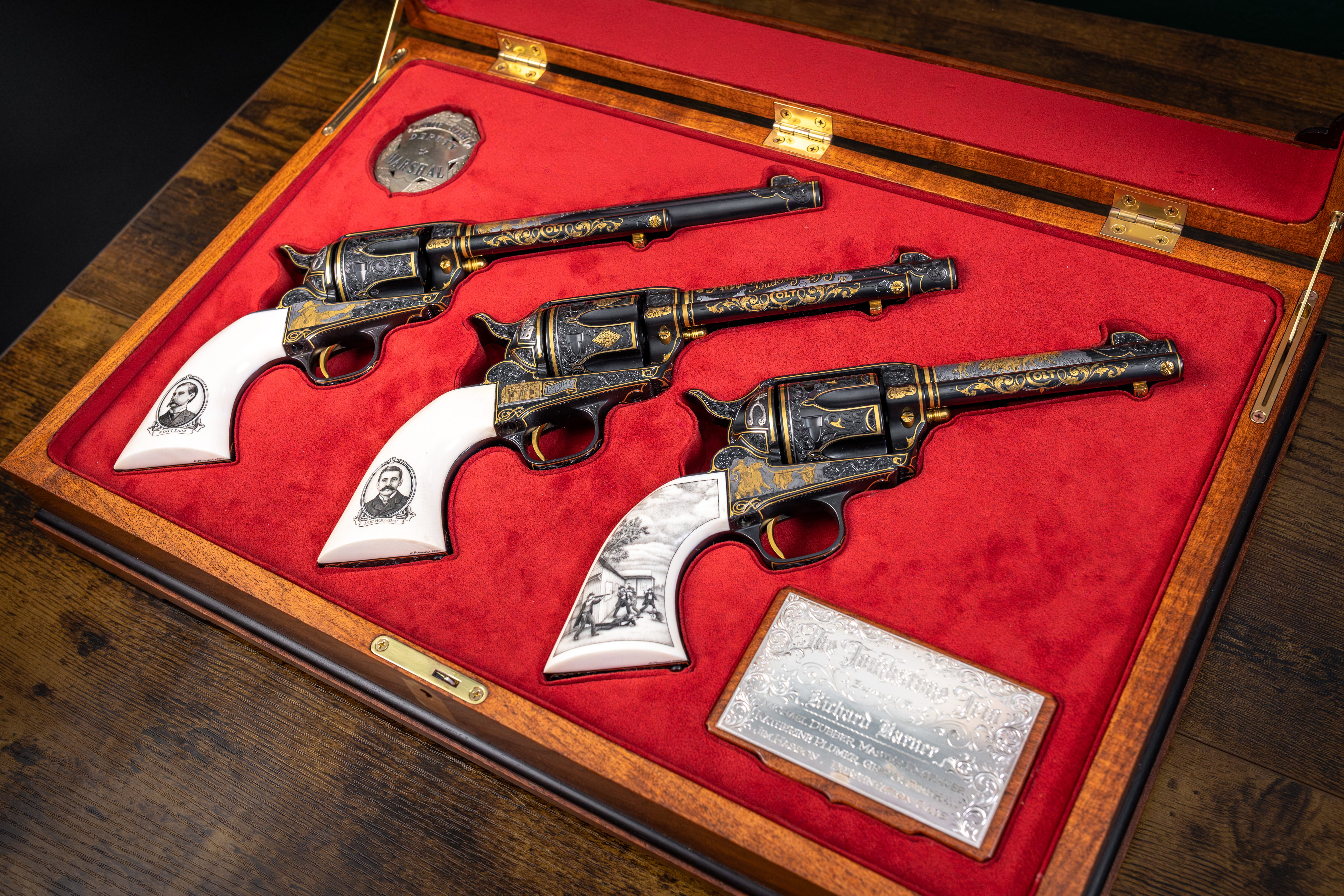
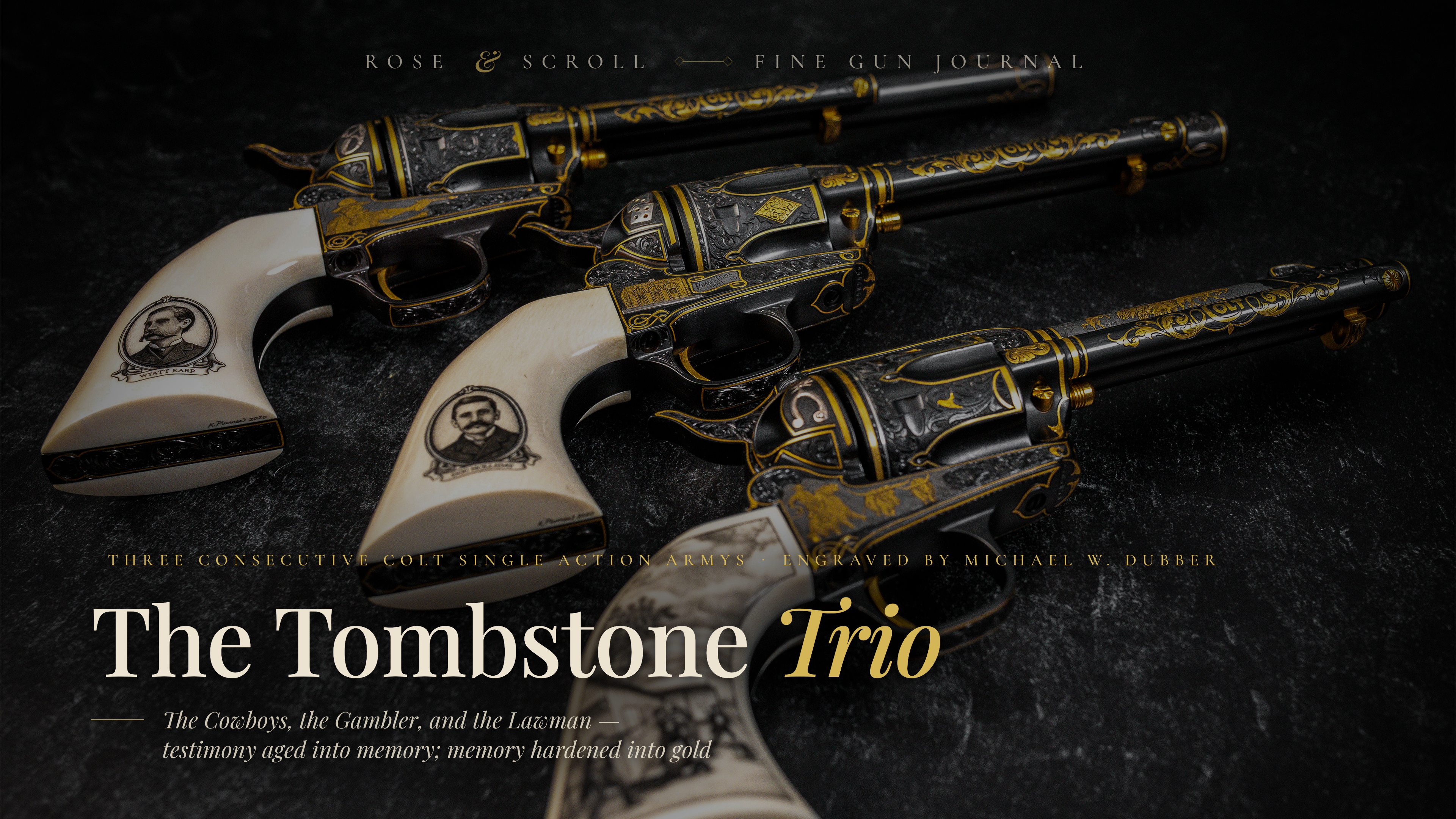
Nearly a century and a half later, all of it—the stage, the bargain, the gunfight, the hearses—rests together inside a single glass case: not the weapons carried on Fremont Street, but three consecutively numbered Colt Single Action Armys from the hand of Master Engraver Michael W. Dubber.
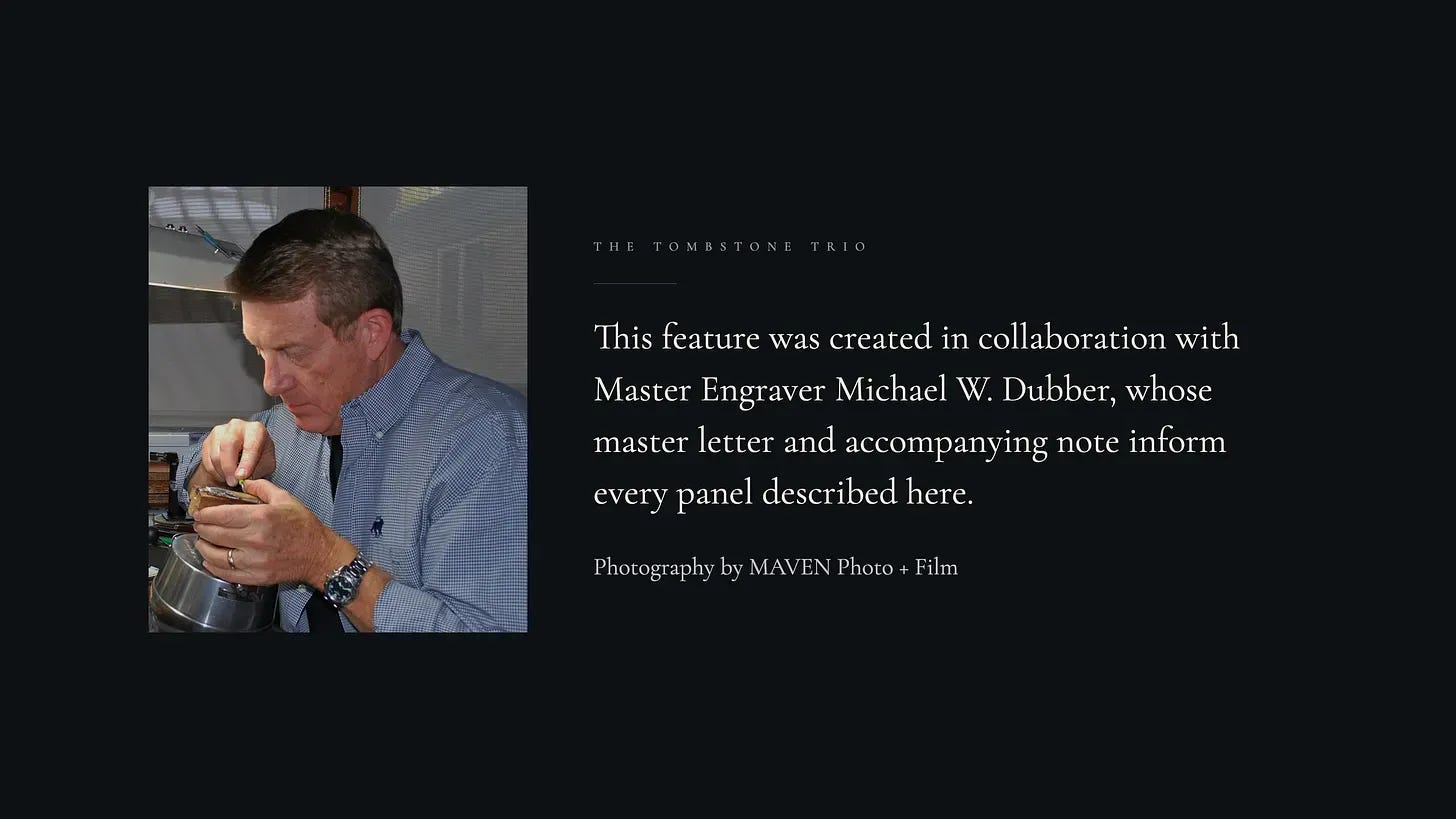
Engraver Michael W. Dubber, whose master letter and accompanying note inform every panel described here, and with photography by MAVEN Photo + Film. If you have a fine gun with a story to tell, reach out to us at contact@roseandscroll.com—we would love to tell it with you.

The Commission
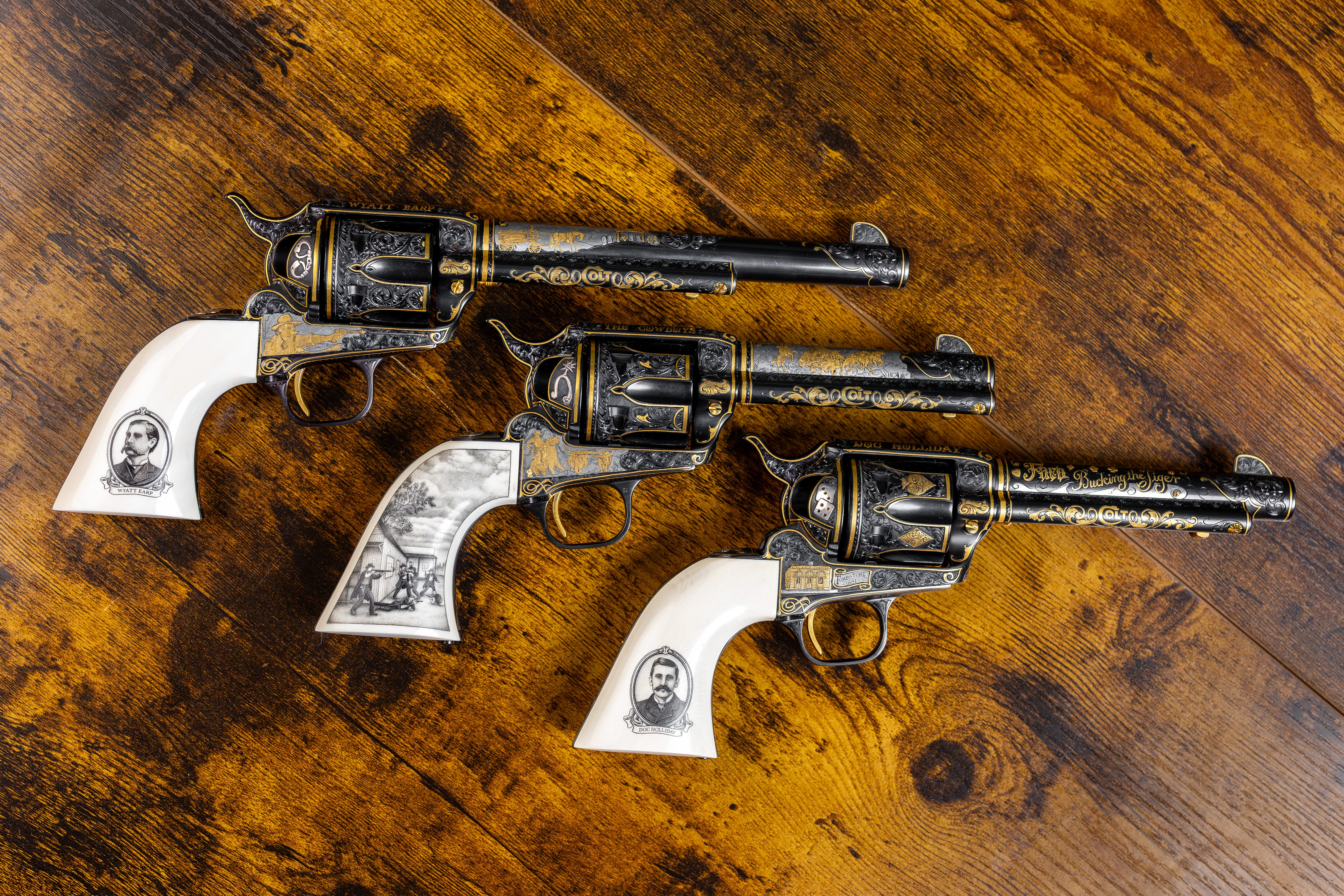
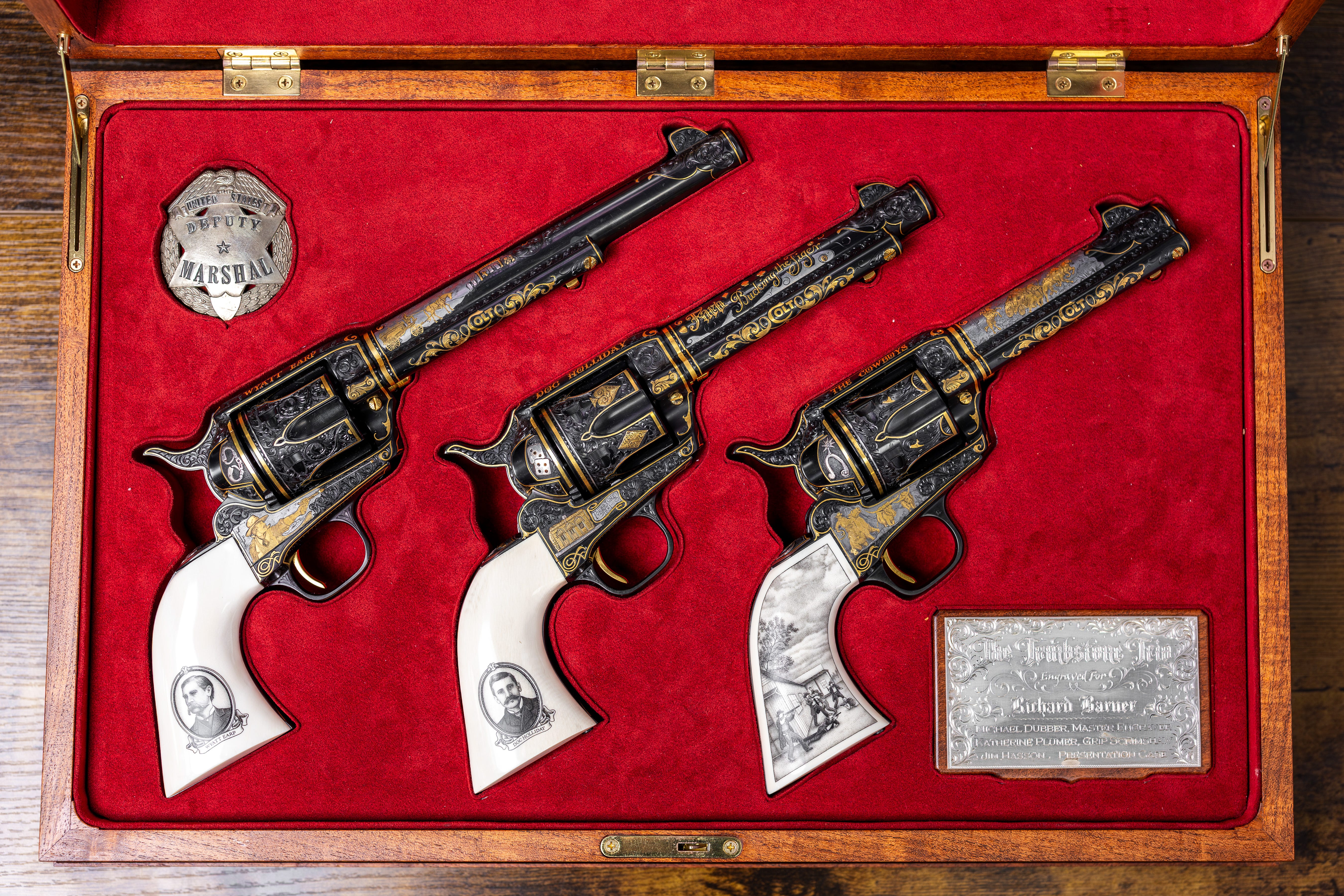
A commission of three Colt Single Action Army revolvers in .45 Colt, serial numbers S60805A, S60806A, and S60807A. The consecutive numbers use the split-letter serial format Colt introduced around 1993–94 after the earlier third-generation sequence had been exhausted. The guns take the three standard barrel lengths: 4¾, 5½, and 7½ inches, commonly called the Civilian, Artillery, and Cavalry lengths by collectors. Those names are conventions rather than first-generation Colt model designations; Colt also supplied other lengths to order.
The platform is the Model of 1873. First-generation production reached approximately 357,000 revolvers, nearly half chambered in .45 Colt. The serial sequence and three-length configuration are the more immediate points here. Dubber wrote in his accompanying note that he was unsure whether another such set existed. Consecutive engraved pairs and larger consecutive groups have appeared, including a second three-gun Dubber set and a six-gun commission shipped as three consecutive pairs in 1985. No second set of three consecutively numbered Single Action Armys spanning all three standard barrel lengths was found in the public records consulted for this feature. Its distinction lies in that precise combination.
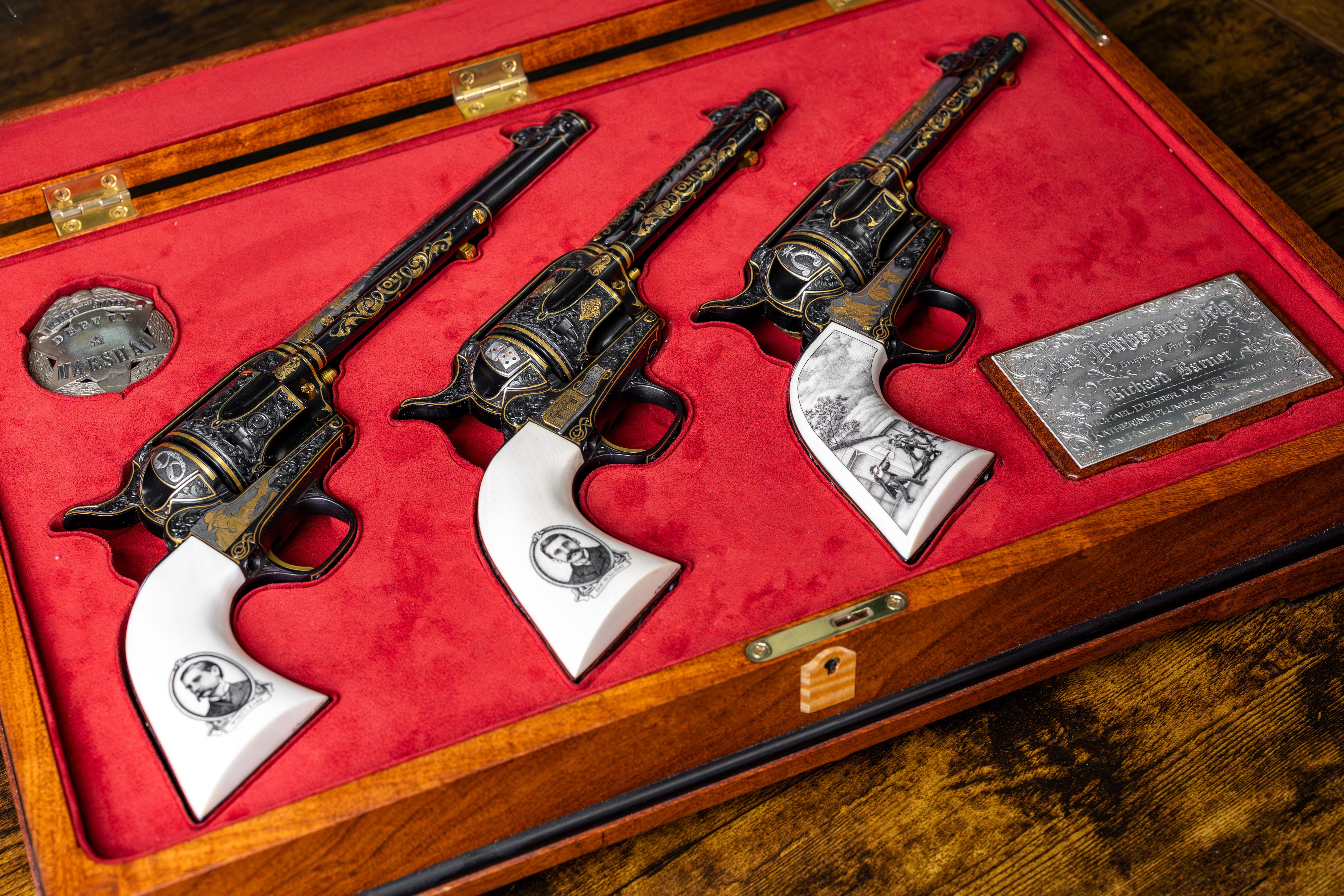
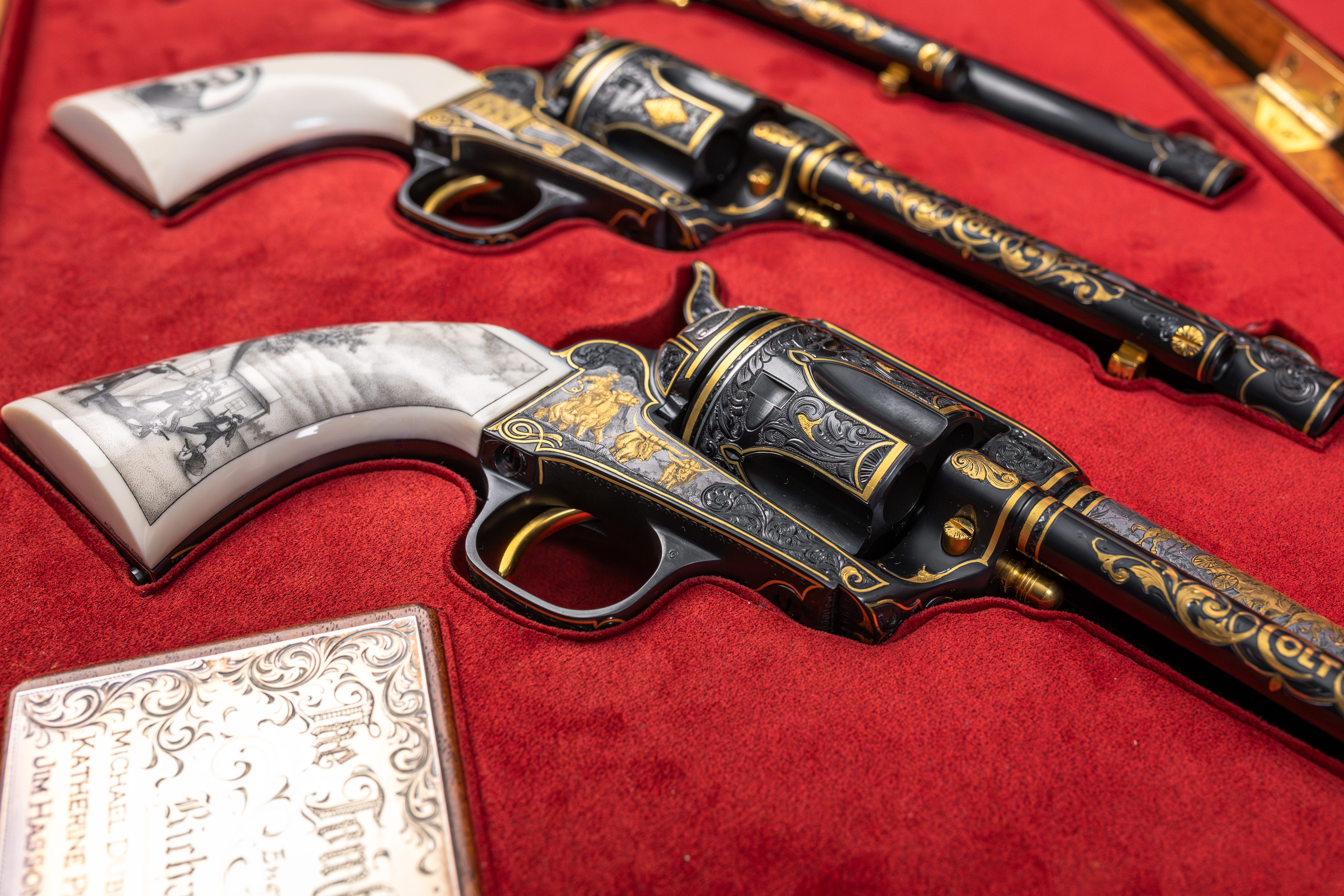
Dubber’s accompanying note records 3.8 troy ounces of fine gold across the three revolvers. The master letter separately describes silver and platinum, flush and raised work over blued steel and French-grayed pictorial grounds, and twenty-four-karat gold lines bordering the principal panels. It calls the work Exhibition Grade. Katherine Plumer scrimshawed the elephant-ivory grips; “K. Plumer 2020” on the Wyatt Earp portrait dates her signed work, though not necessarily the set’s final assembly. Jim Hasson built the presentation case. H.B. Norris III served as Project Wrangler and secured the original U.S. Deputy Marshal badge mounted on the case. Turnbull Restoration finished and assembled the revolvers, and Reliable Electroplating of Chartley, Massachusetts, is credited specifically with gold plating.
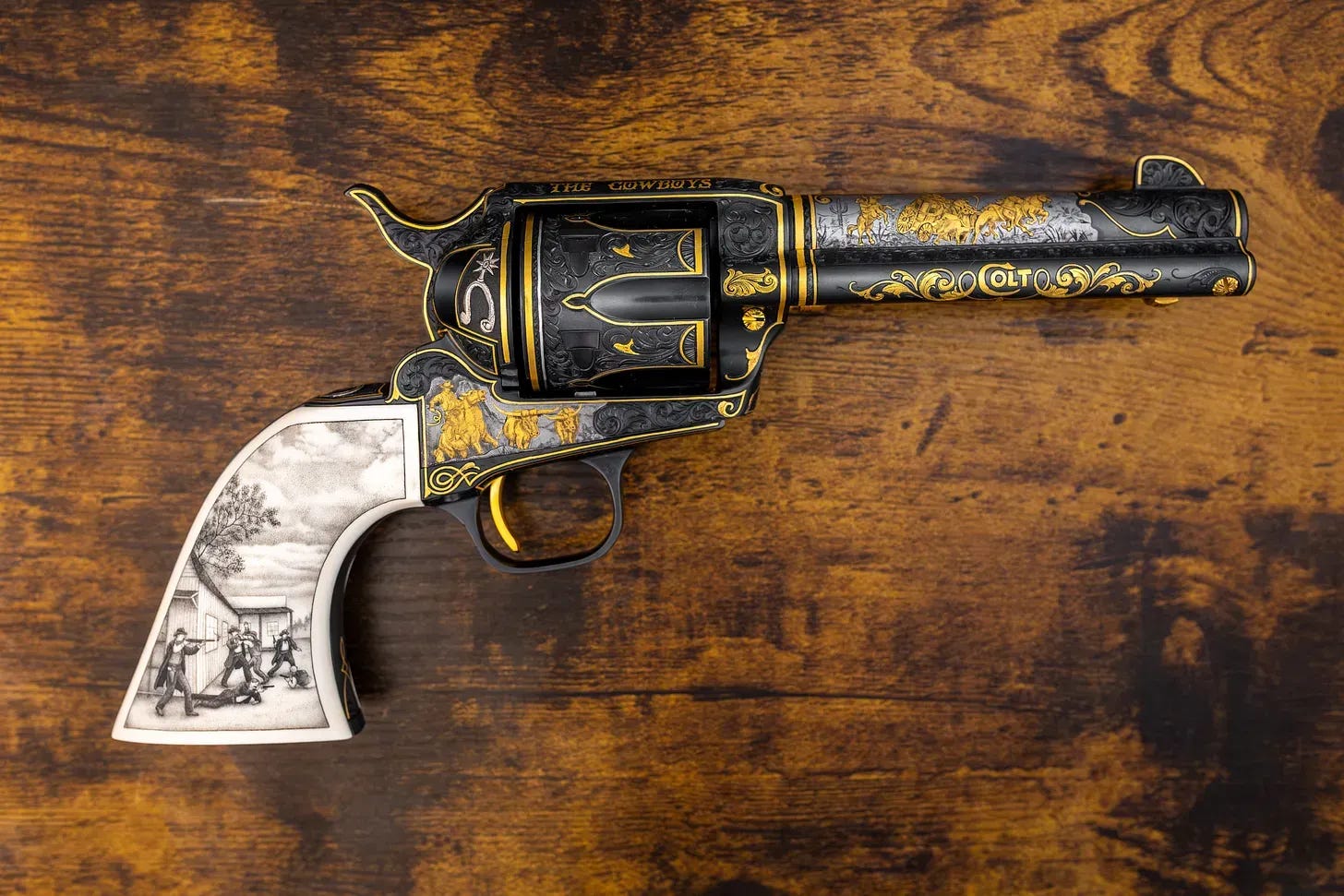
The Cowboys Colt · 4¾ Inches · Serial S60805A
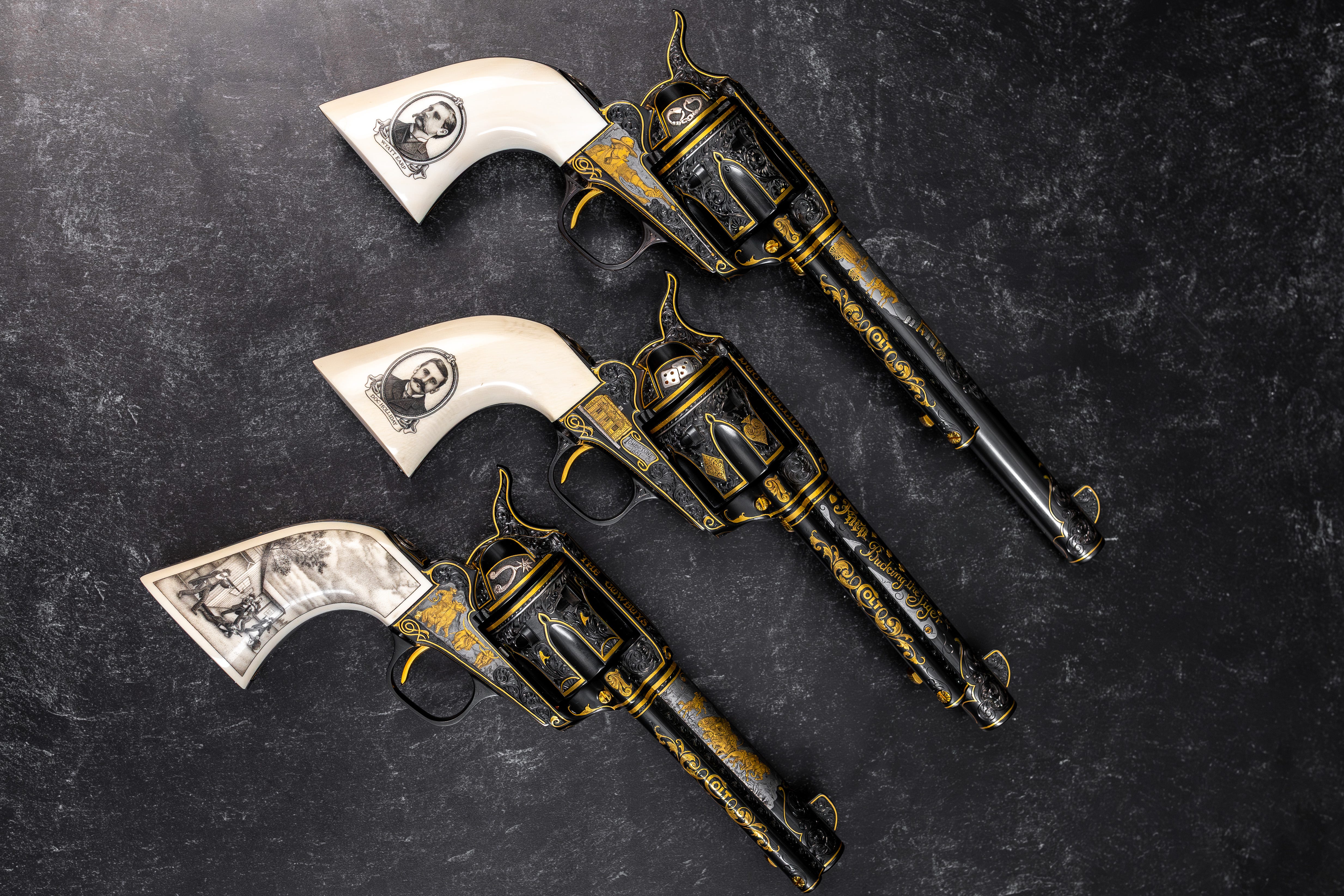
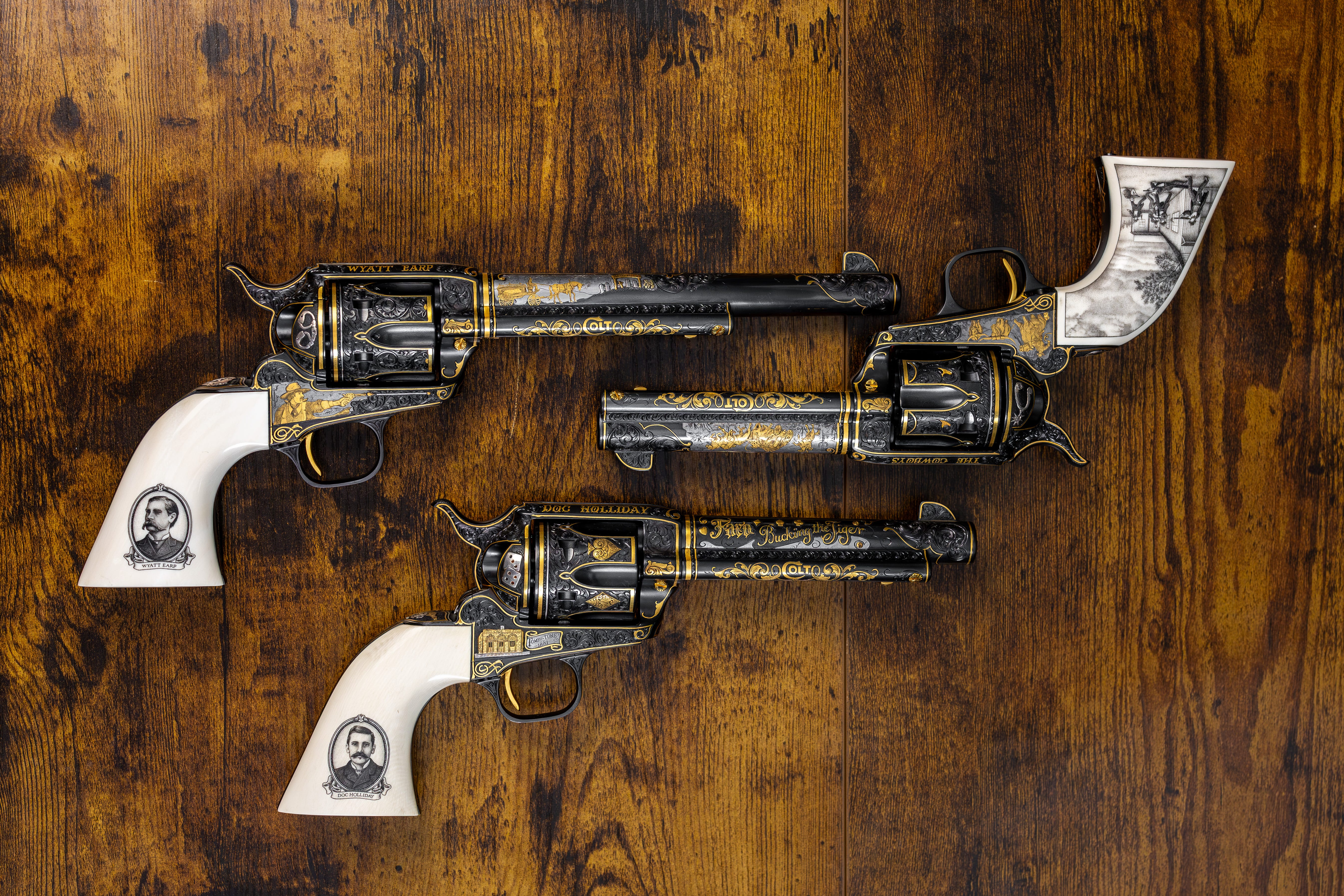
The shortest barrel keeps the hardest company. Across the topstrap, in rough-cut gold letters, runs THE COWBOYS, assigning the revolver to Ike and Billy Clanton, the McLaurys, Curly Bill, and the wider network covered by the name. Above the cylinder, a longhorn’s horn runs nearly the length of the top frame, gold wrapped at its center in silver.
The barrel returns to the robbery that helped set the later quarrel in motion. Across a French-grayed desert, a gold coach and team run at full stretch while a mounted gunman raises his pistol. The Kinnear stage robbery is documented; the scale of the treasure traditionally assigned to the stage remains disputed. More consequential was what followed: the search for the surviving robbers and Wyatt Earp’s secret arrangement with Ike Clanton, one of the grievances that would surface again in October.
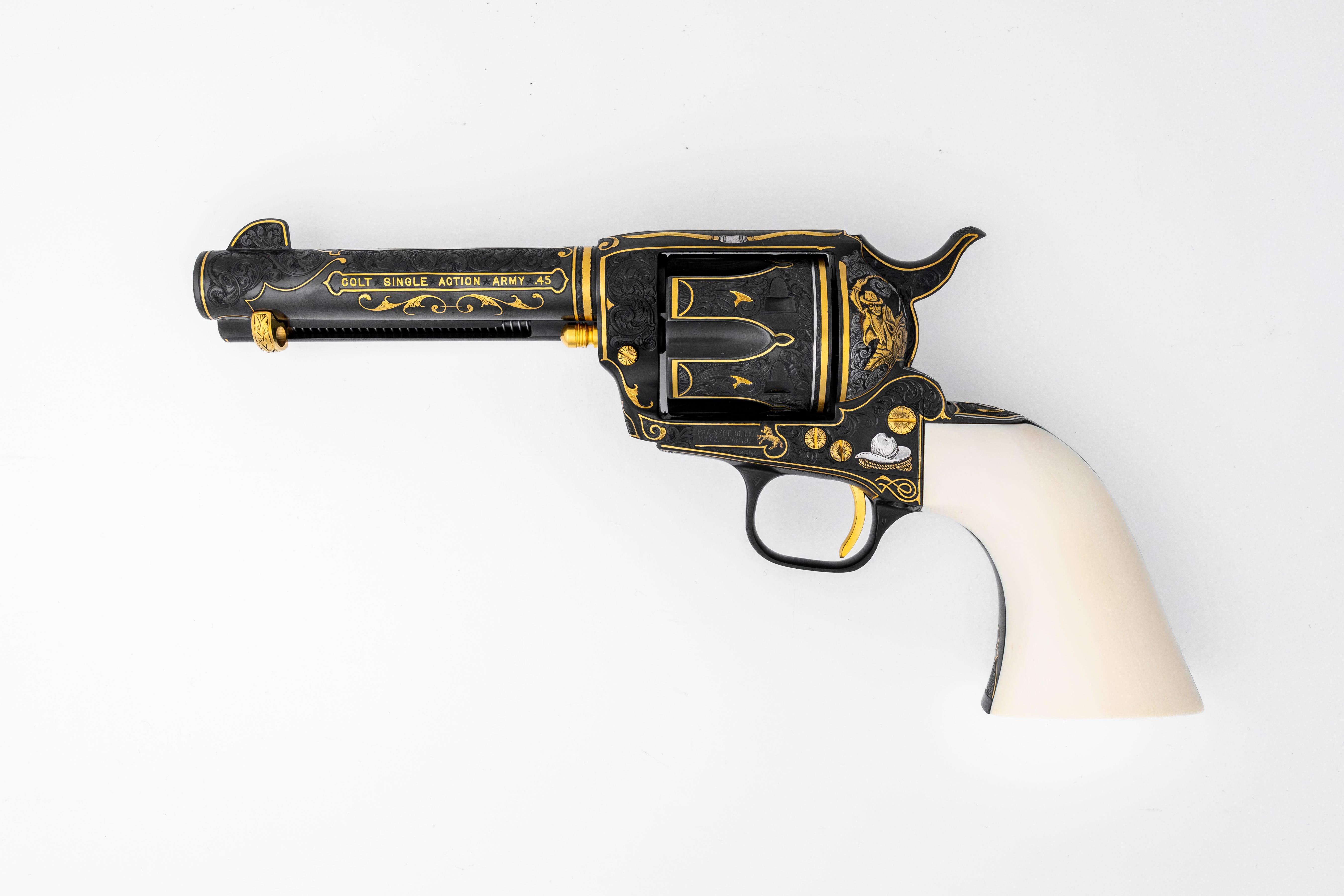
The right frame carries a cattle-rustling panel: mounted men pushing longhorns through rough country. This is contextual imagery rather than a rendering of a single documented event. Cross-border cattle theft was part of the Cow-boy economy, and contemporary and later accounts tied the Clanton and McLaury ranching network to stolen Mexican stock, though individual allegations were contested. Violence answered the trade at Skeleton Canyon and, on August 13, 1881, at Guadalupe Canyon, where Newman “Old Man” Clanton was among the dead.
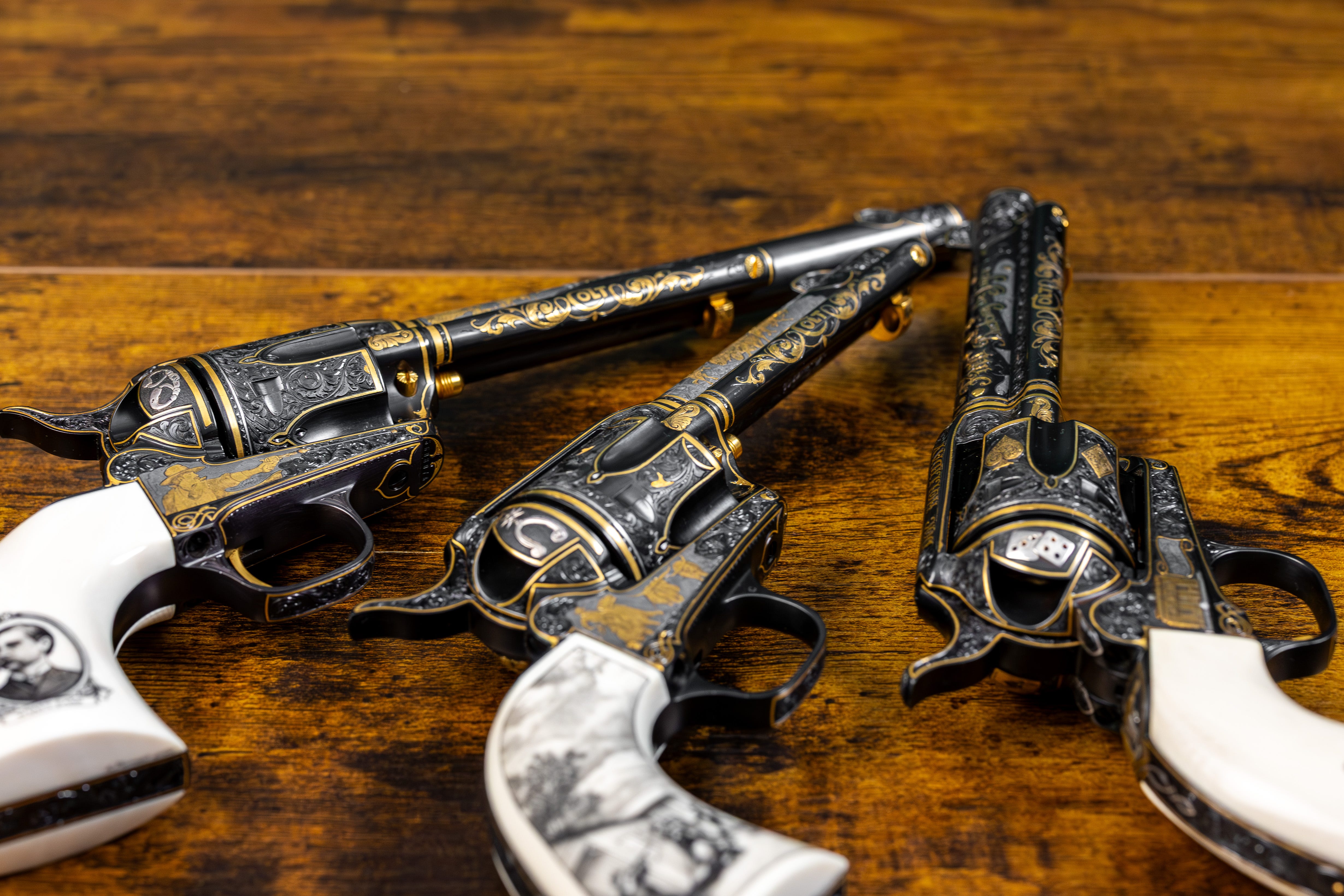
The remaining emblems complete the range vocabulary: a silver hat on a coiled gold lariat at the left panel; a gold rider roping a steer on the recoil shield; silver spurs at the loading gate; and crossed horseshoes, one gold and one silver, on the shovel head behind the hammer.
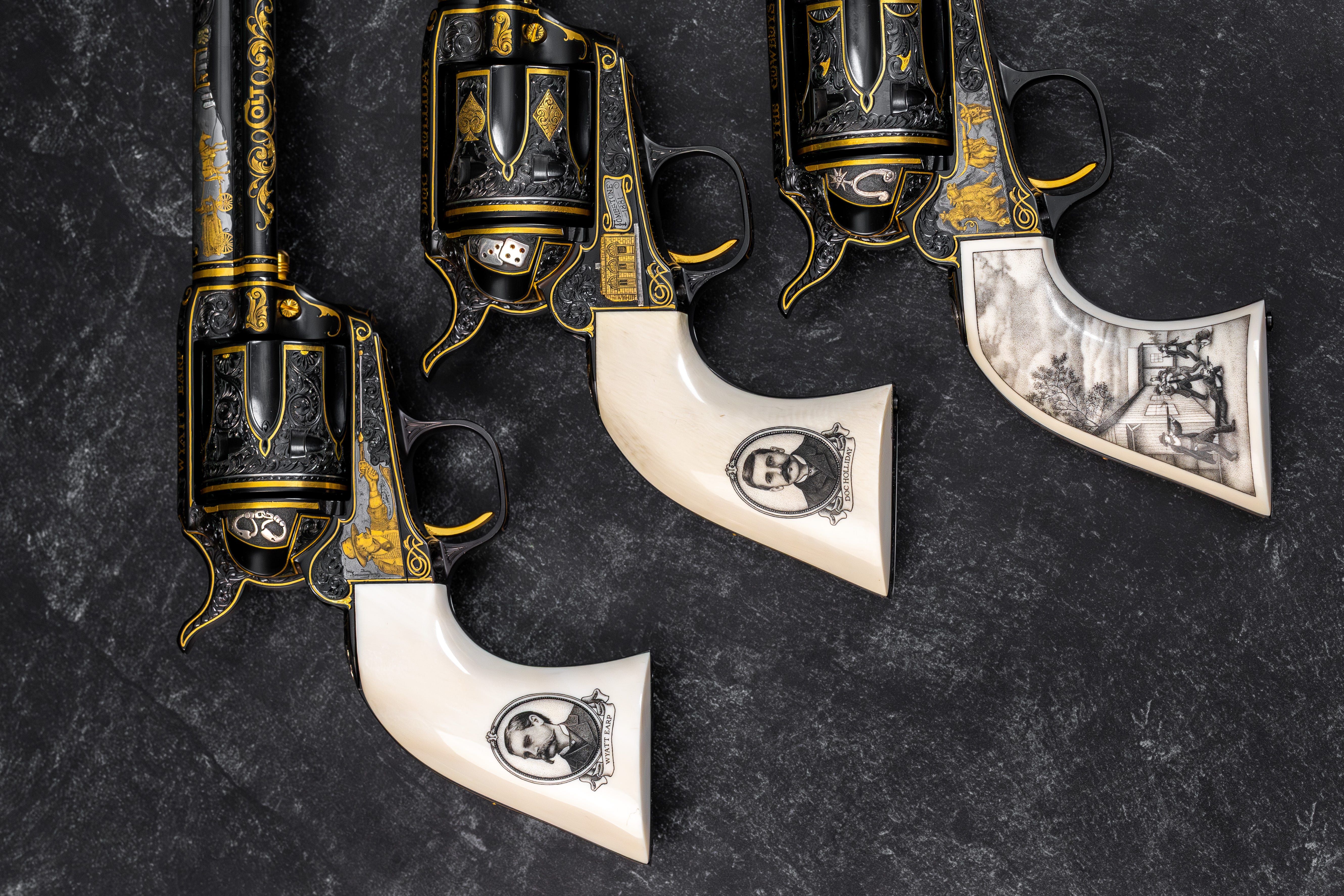
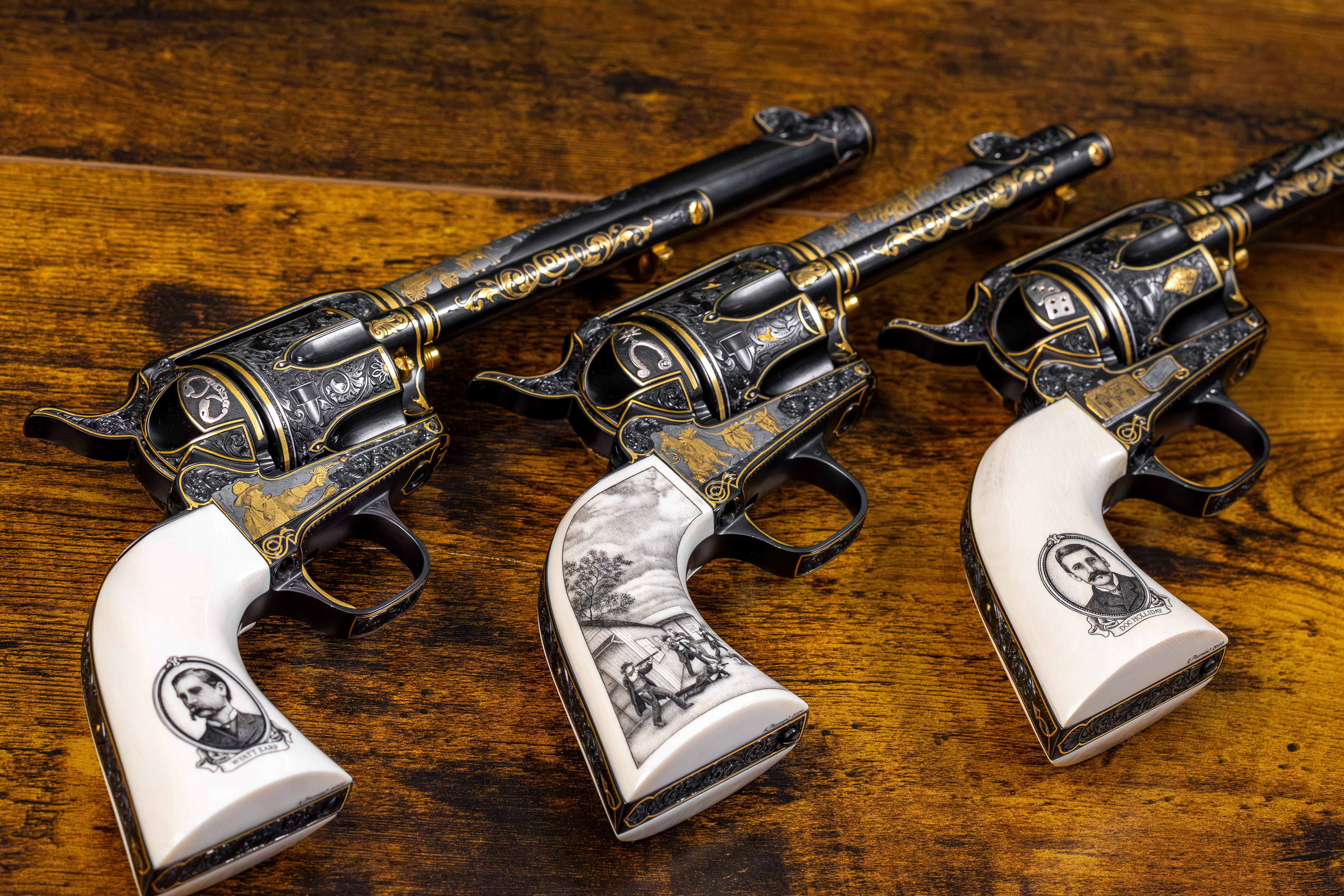
Plumer’s right grip shows the gunfight itself: coat-clad figures firing, crouching, and falling before low frame buildings, one man prone and shooting from the ground. The master letter describes the scene as historically correct—correct the way the fight itself survives, through the testimony taken at the Spicer hearing, where the men who walked out of the lot told those thirty seconds shot by shot.
The Doc Holliday Colt · 5½ Inches · Serial S60806A
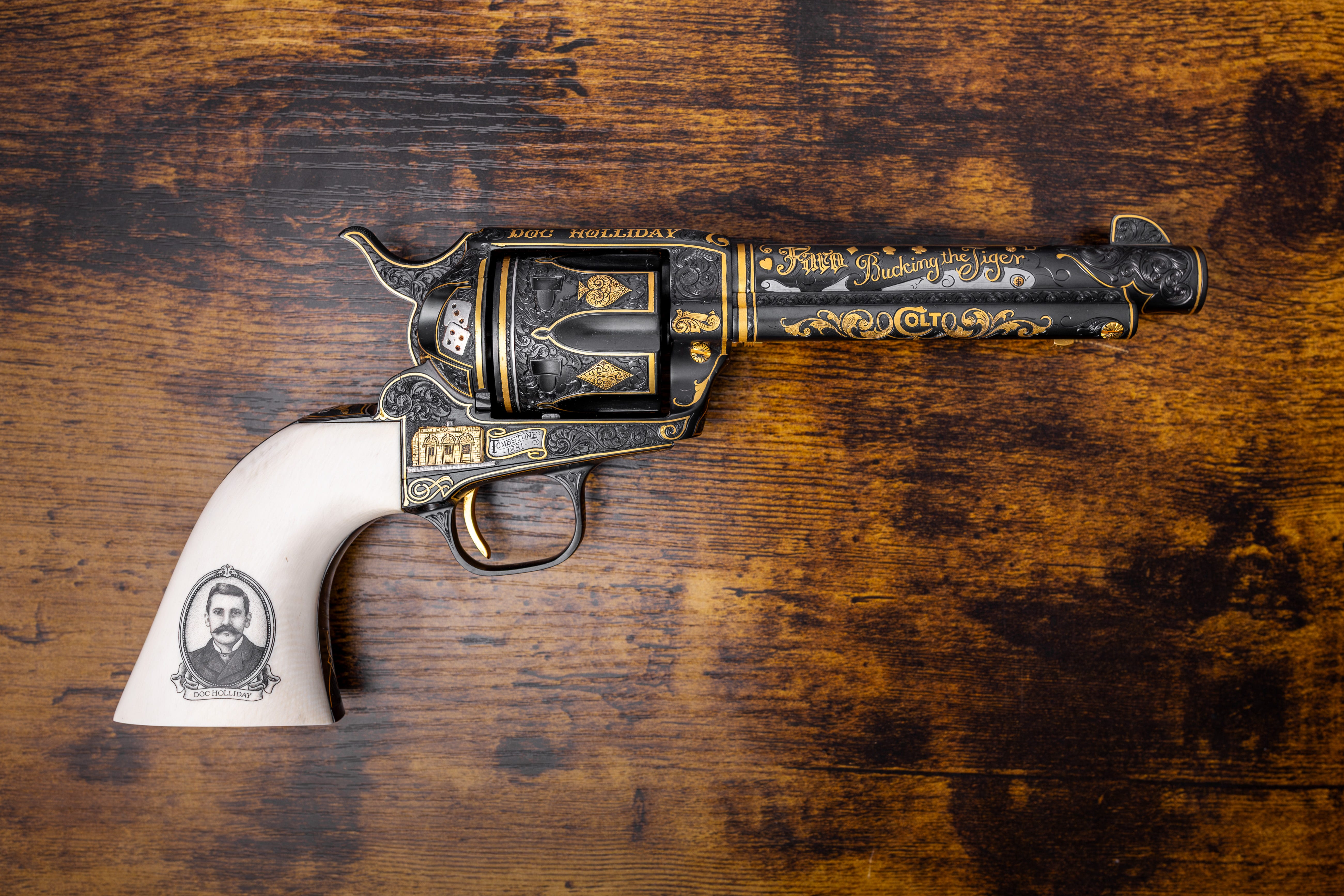
The middle gun carries a dual title in the master letter, “Doc Holliday” and “The Gambler.” Its barrel states the theme in gold script: FARO, and beneath it, Bucking the Tiger. Faro, rather than poker, dominated much of nineteenth-century American commercial gambling. The tiger appeared on period card backs and case-box lids, giving play against the bank its enduring phrase. The burned soda card, two cards drawn each turn, the casekeeper’s abacus, and the copper token that reversed a bet gave an honest bank only a narrow advantage. Honest banks were less common.
Both Holliday and Wyatt Earp dealt faro, and Earp held an interest in the game at the Oriental. Around that documented association, the engraver built a period gambling vocabulary: fine-silver dice set with seven black diamonds at the loading gate; the four card suits in gold around the cylinder’s circumference; and a royal flush, ten through ace of spades, fanned across the recoil shield.
On the right frame, the legend finds its address. Beside a silver scroll reading “Tombstone 1881” stands a gold-and-silver vignette of the Bird Cage Theatre, opened that December. In the master letter’s words, “in 1881 it was where Doc Holliday dealt FARO,” and everything the town’s memory holds dearest gathered under that roof—the famous newspaper superlative, the poker game that ran for years, the faro bank and its tiger—with Holliday’s chair at the center of it. The vignette gives the gambler the room the legend built for him.
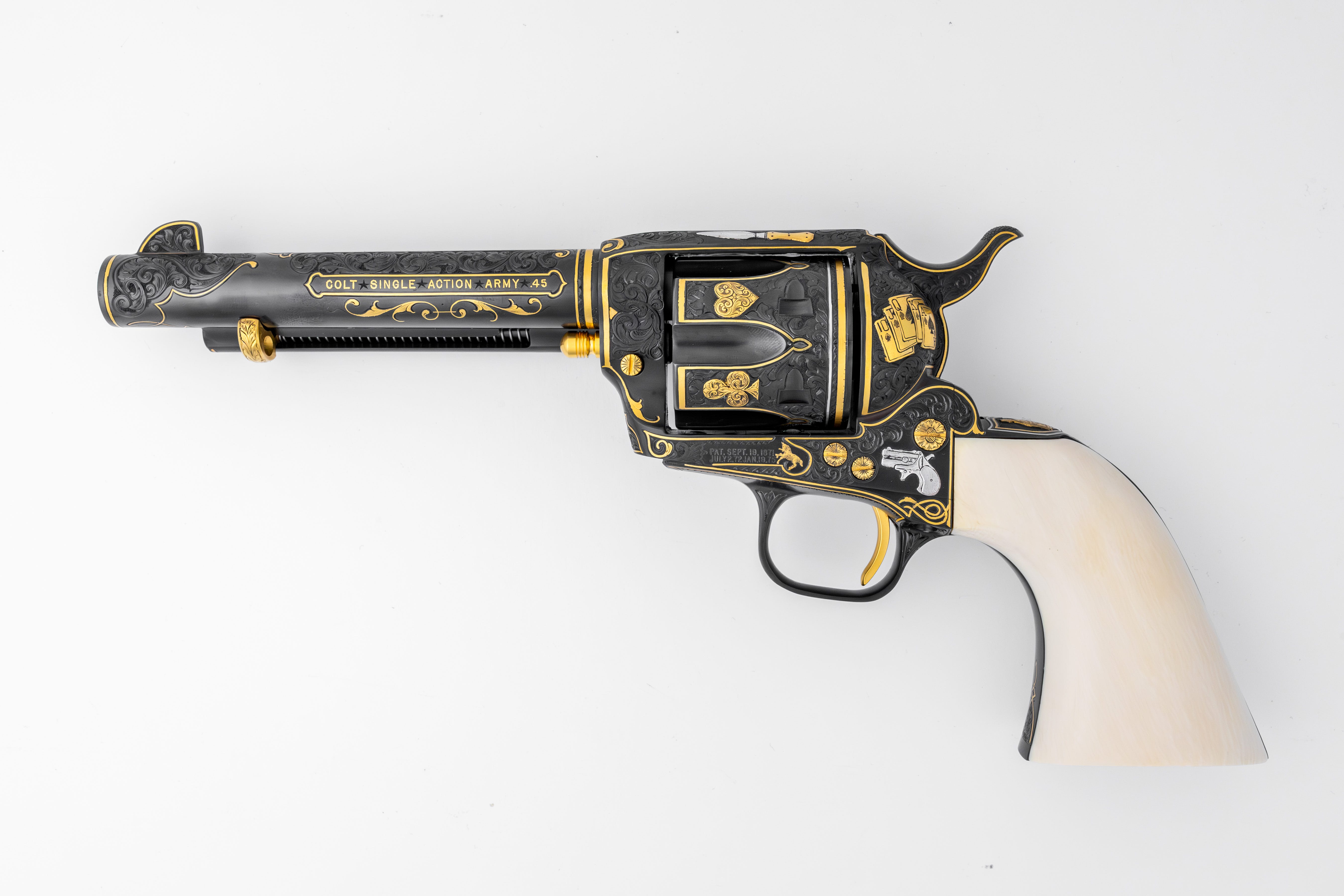
The personal effects fill in the man the legend remembers: Old Overholt, the Pennsylvania rye that tradition set at his elbow; the Remington derringer engraved “To Doc from Kate,” token of the stormiest attachment in the story; and the push dagger—period accounts agree the dentist carried a formidable blade. Each object is part of how Holliday has been remembered, and the engraver gives each its place.
A family piece anchors the firearms: a Colt Model 1851 Navy given to Holliday by his uncle, Dr. John Stiles Holliday, and kept through the family. At the Spicer hearing, witnesses remembered a nickel-plated pistol in Holliday’s hand on Fremont Street, and a nickeled revolver has ridden with him through every retelling since. The silver cup completes the table: whiskey, cards, dice, and the cup among them—the gambler’s still life in silver and gold.
The right grip bears Plumer’s portrait of Holliday, an oval medallion with beaded border and ribbon banner, the face built in line and stipple after the manner of a Victorian cabinet card. Holliday was a Georgia-born, Philadelphia-trained dentist who developed tuberculosis, went west at twenty-two, and died in Glenwood Springs at thirty-six. On this revolver, the dentist, the gambler, and the legend occupy the same steel.
The Wyatt Earp Colt · 7½ Inches · Serial S60807A
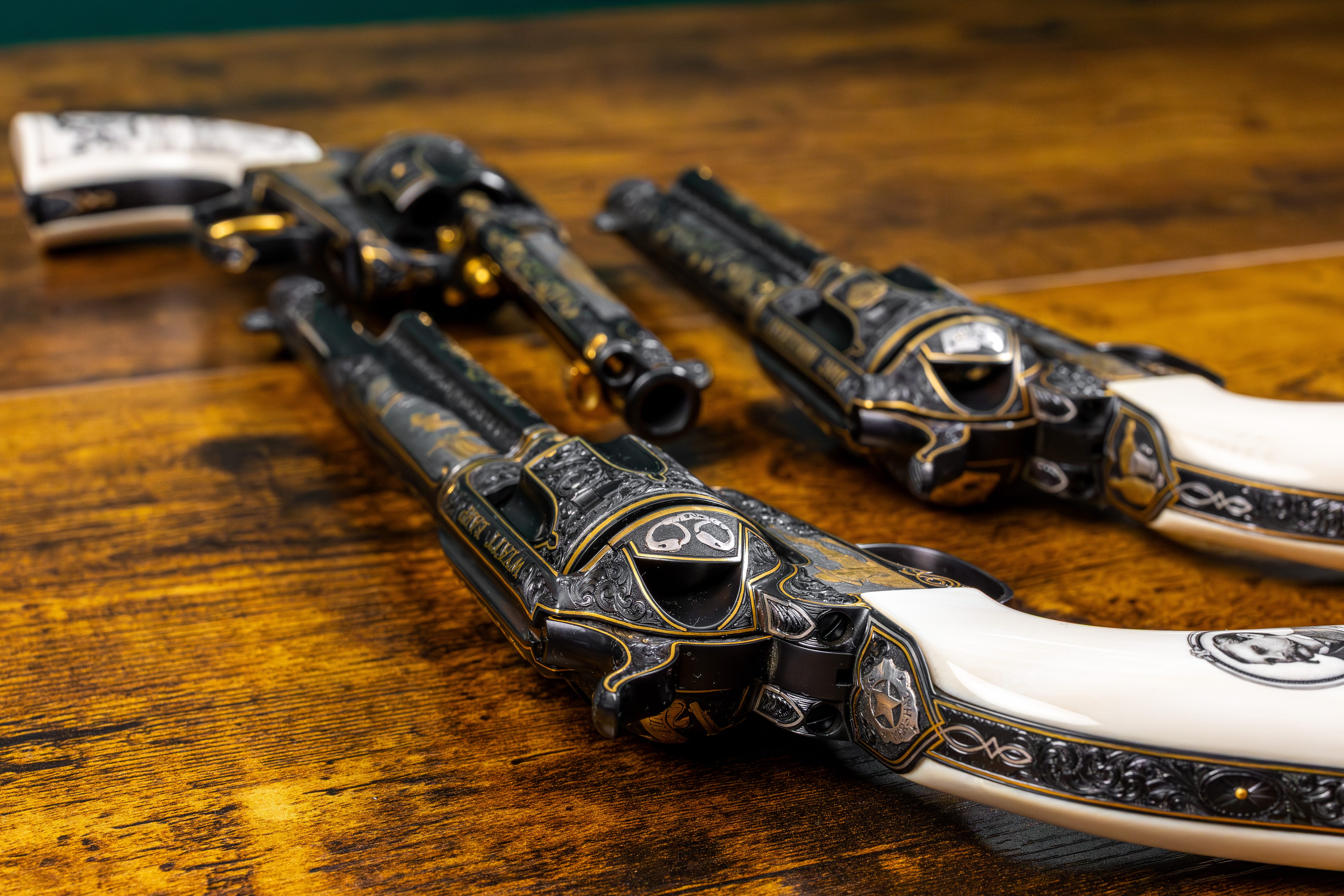
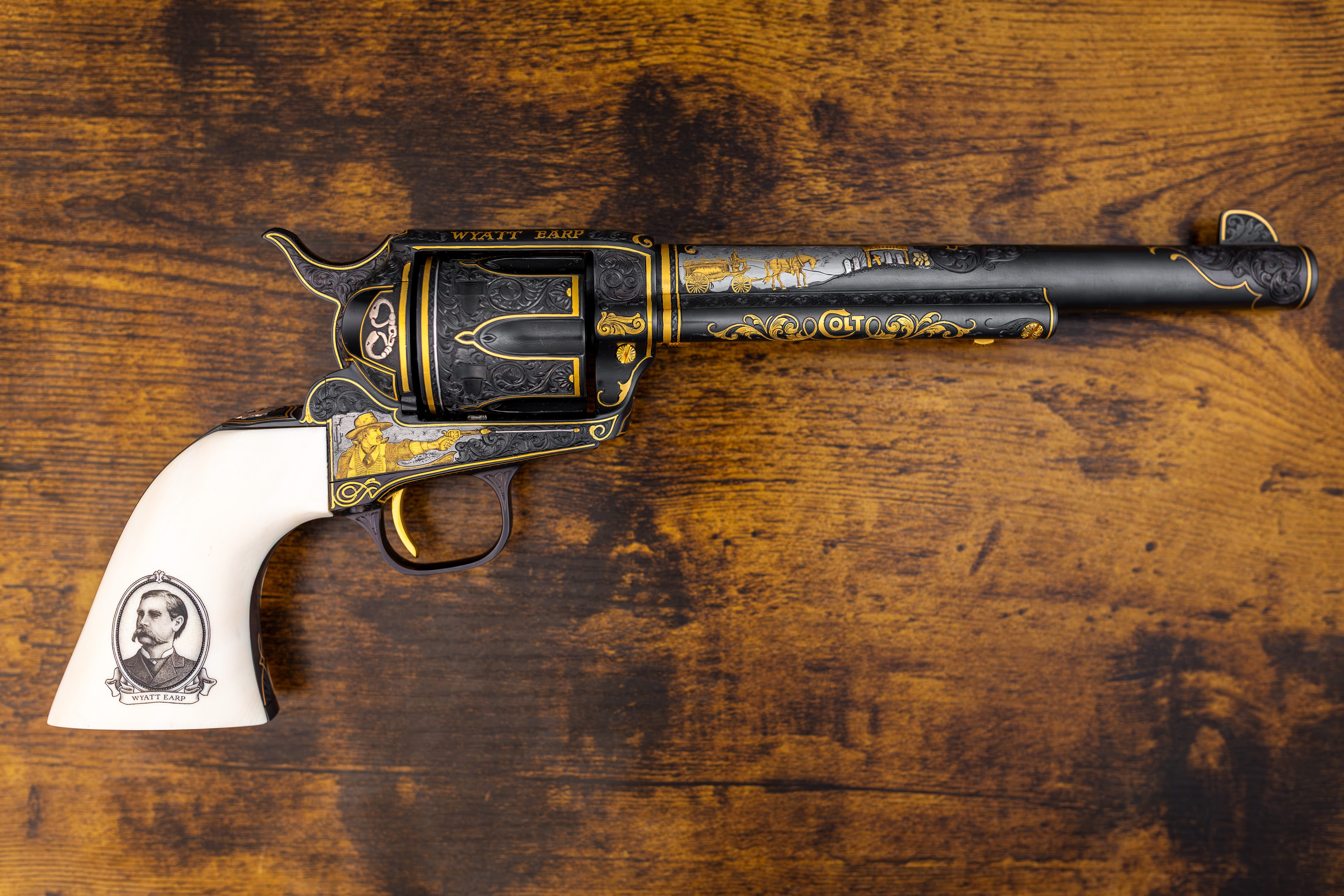
The longest barrel carries the memorial gun. Two badges appear in silver: a marshal’s star on the shovel head and a Tombstone deputy sheriff’s badge on the recoil shield—the emblems of a working life spent wearing metal. Earp was a Wichita policeman, a Dodge City assistant marshal, a Pima County deputy sheriff, a deputy under Virgil on the day of the gunfight, and, after Virgil’s ambush, a deputy U.S. marshal—the appointment he wired for on December 29, 1881, the day after his brother was maimed. The star and the shield gather that scattered service into the lawman the legend remembers.
The letter also notes that Earp “worked the outer margins of the law,” with gambling among his principal incomes. Modern biographers have described him as a sporting man first: faro dealer, saloon interest-holder, and intermittent officer. That record is less tidy than the screen marshal and more useful to understanding Tombstone.
The right frame shows Earp firing his revolver, with silver handcuffs at the loading gate. On the recoil shield, a gold banner lettered TOMBSTONE rises above an inlaid revolver identified by the master letter as his 7½-inch Colt.
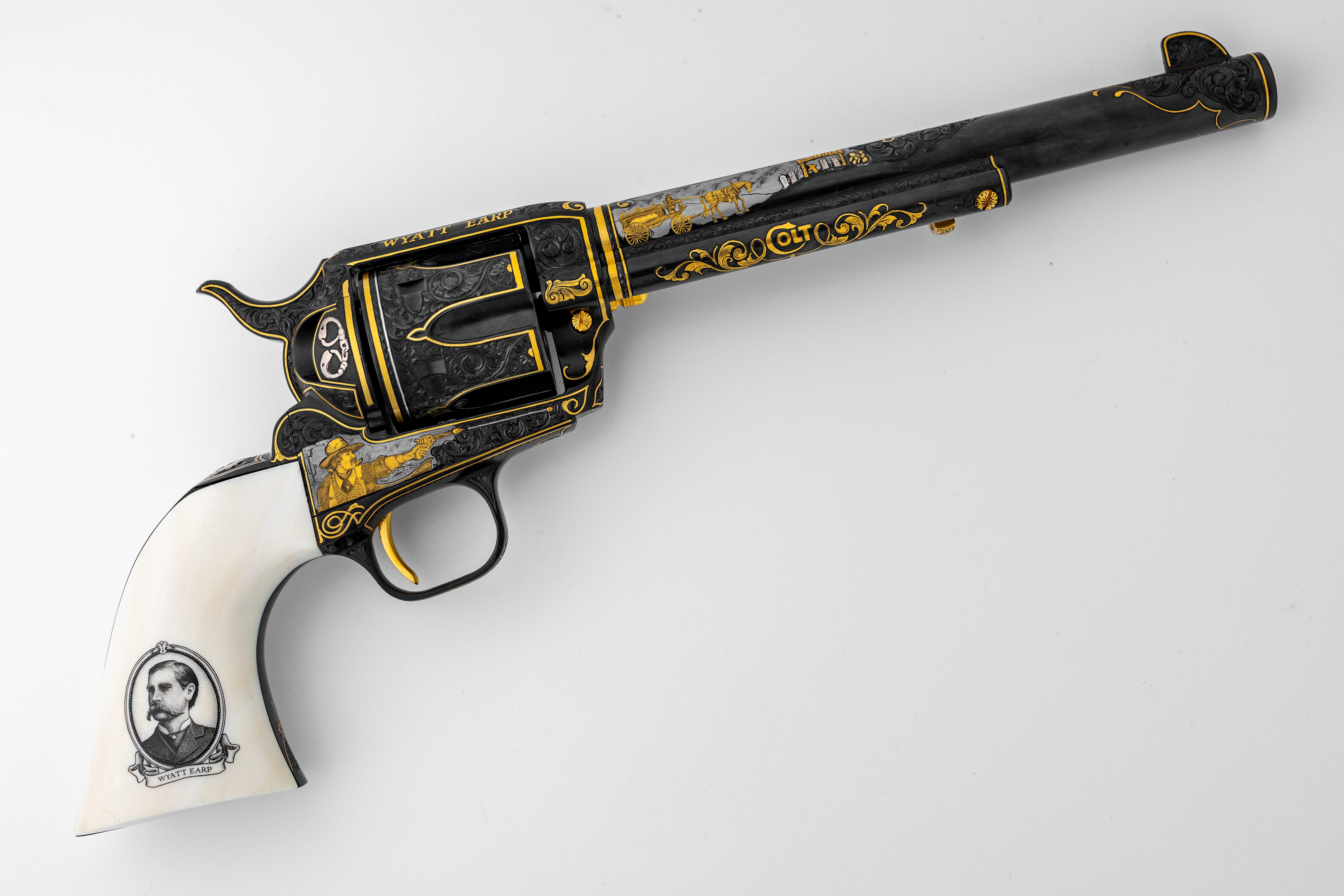
The left panel turns memorial: a gold pocket watch and vest chain, the case engraved “Wyatt Earp 1848–1929.” The master letter remembers Earp giving watches to several confidants—keepsakes from a man who outlived nearly everyone who stood in the lot.
The barrel turns from lawman emblems to consequence: the funeral scene. Across a French-grayed ground, a gold horse draws a Tombstone hearse past grave markers and a small gold cross toward Boothill. Boothill is itself a later coinage—in 1881 the ground was simply the town cemetery—but it is the name the legend settled on, and the engraving speaks the legend’s language. The letter identifies the dead as the three men killed on Fremont Street. The October 28 Tombstone Epitaph called the funeral “numerically one of the largest ever witnessed in Tombstone,” described the brass band, and recorded two hearses: Billy Clanton in the first, the McLaury brothers side by side in the second. The rival Tombstone Nugget supplied the fuller procession count—about three hundred mourners on foot, twenty-two carriages and buggies, a four-horse stage, and horsemen, the line nearly two blocks long. The engraving compresses those two hearses and the larger cortege into one carriage.
Wyatt walked out of the lot untouched and stayed that way: the record contains no confirmed gunshot wound to him, ever, though later stories tell of bullets passing through his coat and his saddle. The charm held for forty-seven more years.
Plumer’s portrait grip completes the third revolver in the same oval-and-ribbon manner as Holliday’s. The three guns end in three places: the Cowboys’ in a gunfight, Holliday’s in a card room, and Earp’s in a cemetery.
The Hands
Approximately one percent of first-generation Single Action Armys received factory engraving. The vocabulary of those guns—vine scroll over punch-dot grounds, animal and emblem inlays, and precious-metal borders—developed under engravers including Gustave Young and Cuno Helfricht, with important independent work by L.D. Nimschke. Helfricht was at Colt from 1871 to 1921 and led its engraving shop from the mid-1870s. German immigrants both, Helfricht and Nimschke were living and working in America as the events of this story unfolded, and their work stands today at the top of serious collectors’ lists. Their styles are the foundations of American scroll, and working engravers have followed them ever since. It is the tradition Dubber inherits.
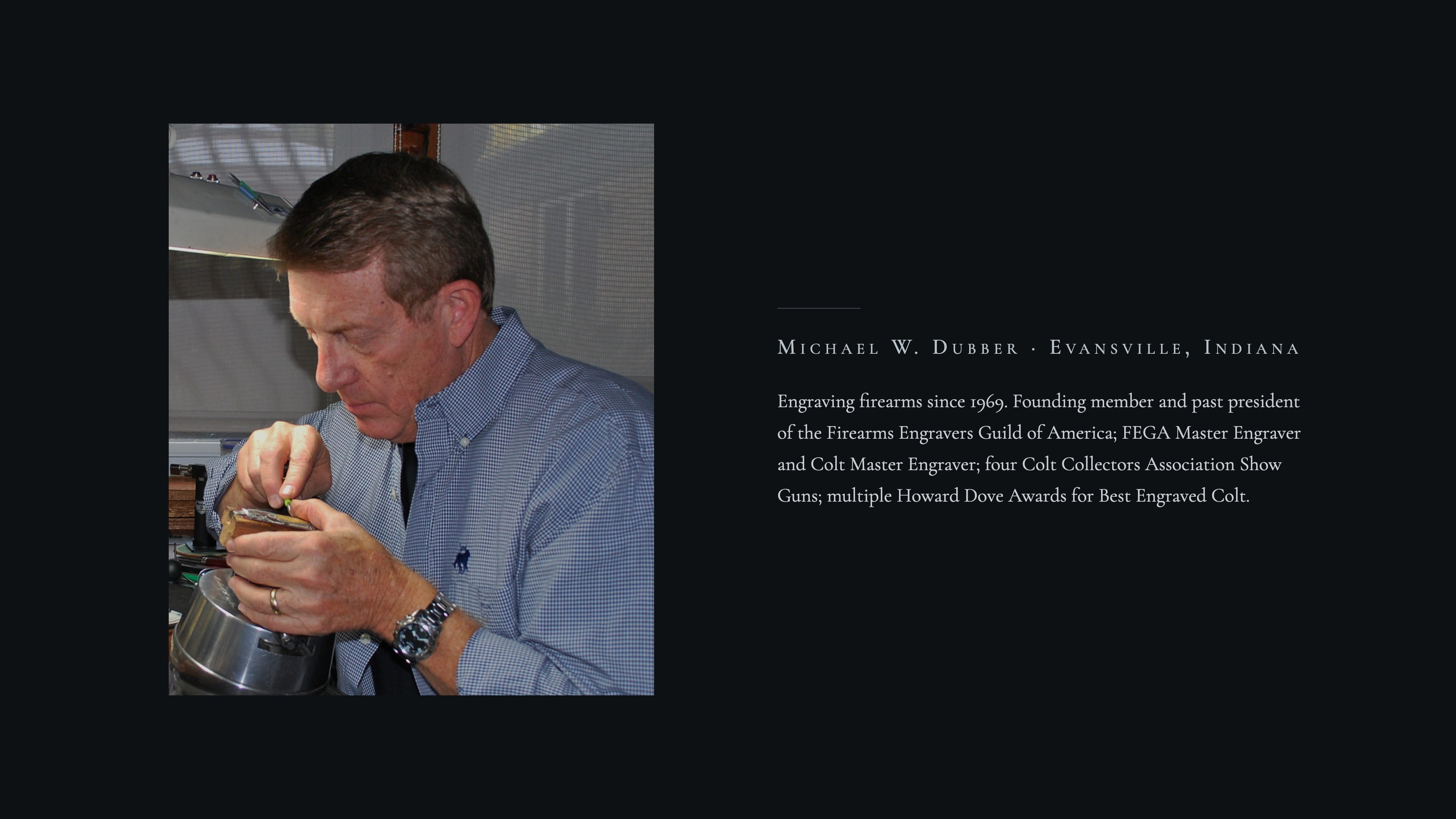
Michael W. Dubber of Evansville, Indiana, has engraved firearms since 1969. A founding member of the Firearms Engravers Guild of America, he served as its president from 1998 to 2004 and holds both FEGA Master Engraver and CCA Master Engraver designations. He has been commissioned for seven Colt Collectors Association Show Guns over a twenty-three-year period beginning in 2003 and has received multiple Howard Dove Awards for Best Engraved Colt.
The master letter distinguishes raised and flush inlay from gold plating. In inlay, channels are cut and undercut so that the precious metal locks mechanically into the steel; wire forms the line borders and sheet supplies the larger figures. Raised work stands above the surrounding surface, while flush work is leveled with it. The letter separately credits Reliable Electroplating for gold plating. Those processes should not be collapsed into a single description.
French-grayed grounds provide a soft, matte silver-gray field against which the cuts read, a half-tone above the surrounding blue. Even the screw heads are composed as gold rosettes. The 3.8 troy ounces of gold are best understood as a measure of the labor required to prepare, undercut, lay, and finish the inlay across three complete revolvers.
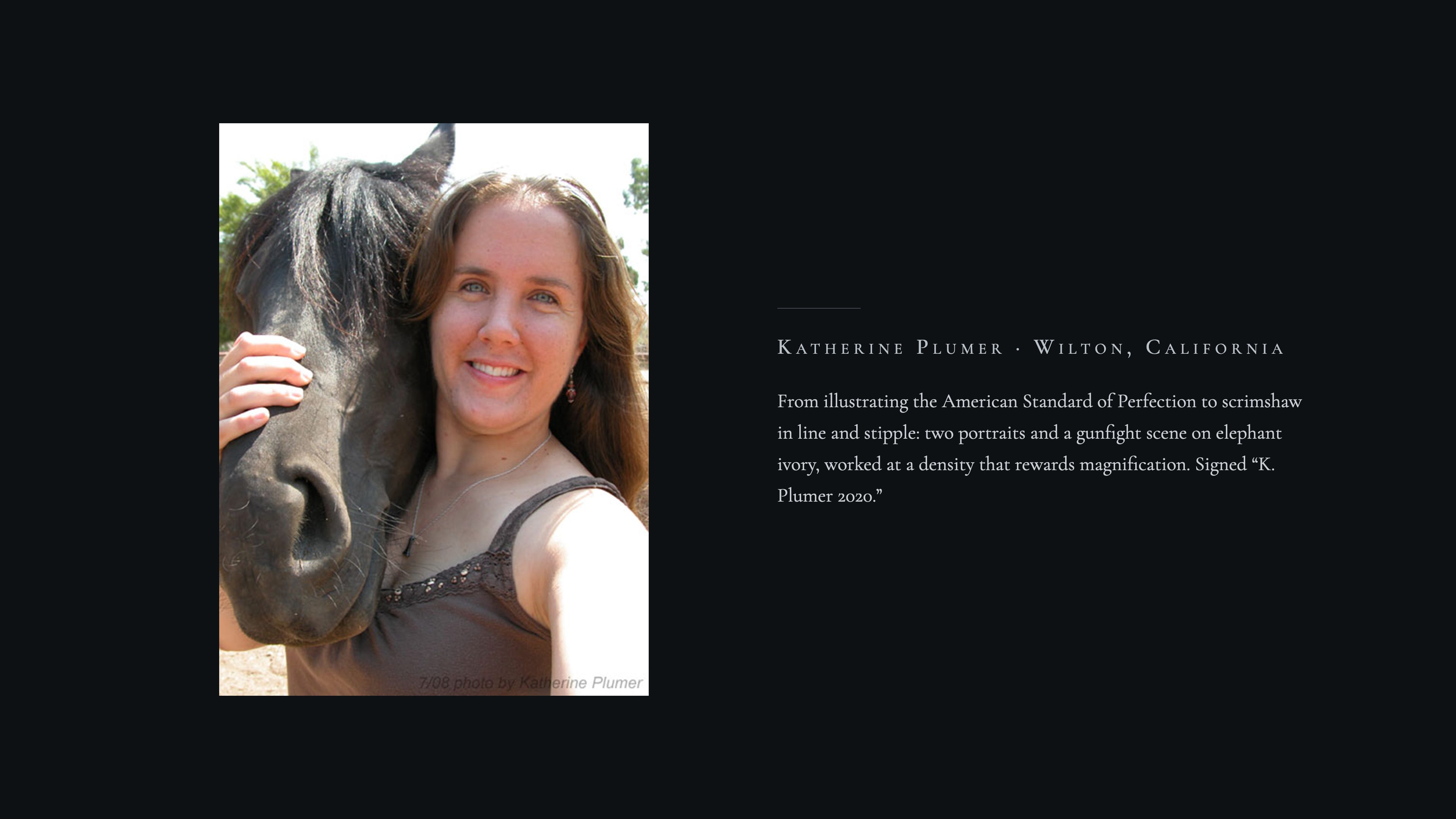
Katherine Plumer of Wilton, California, produced illustrations for the American Poultry Association’s American Standard of Perfection before turning to scrimshaw. Her line-and-stipple method draws on that background in draftsmanship. The three grips comprise two portraits and a gunfight scene, worked at a density that rewards magnification.
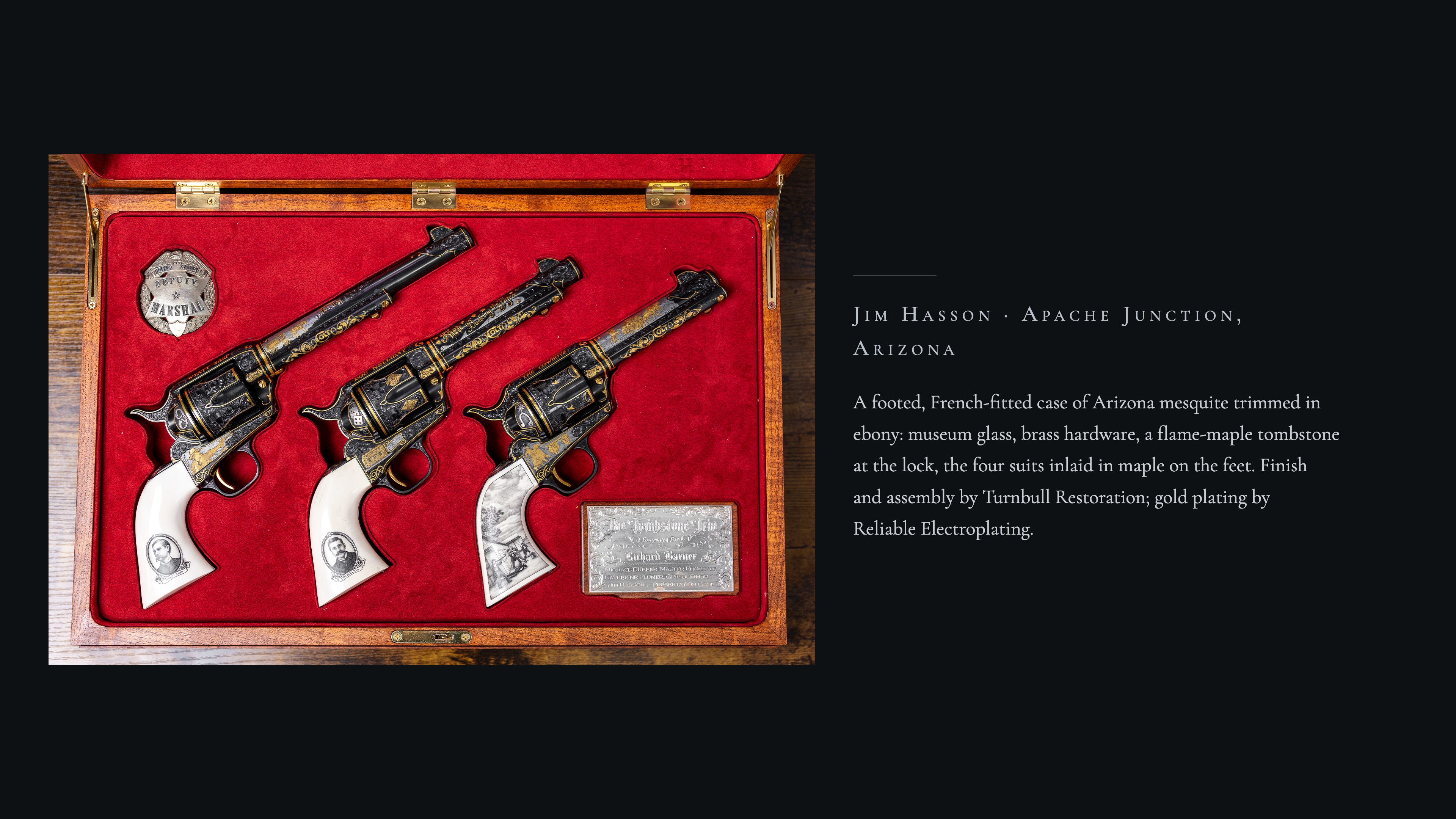
Jim Hasson of Apache Junction, Arizona, built the presentation: a footed, French-fitted case of Arizona mesquite trimmed in ebony, with museum glass, brass hardware, a flame-maple tombstone at the lock, and the four card suits inlaid in maple on the feet. At the top left of the case sits an original U.S. Deputy Marshal badge, historically correct to the period of the gunfight. The lawman’s Colt wears its badges in silver; the case wears the real thing. H.B. Norris III of Houston, Texas—Texas lawman, longtime friend of the engraver, and a hand in many of Dubber’s past commissions—obtained it for the Trio. On this one he is credited as Project Wrangler. Turnbull Restoration handled the gunsmithing and blued finish. Reliable Electroplating carries the master letter’s separate gold-plating credit.
Closing the Case
Inside the case, the three revolvers lie a hand’s width apart—closer than the sides they remember ever stood. The one afternoon those sides came near it, thirty shots crossed the lot in thirty seconds and settled nothing: the quarrel ran on through ambush and vendetta and a longer war of memoirs. It comes to rest here, the Cowboys’ Colt and the lawman’s side by side at last, the gambler’s between them.
Dubber’s gravers laid the story into the steel. Plumer’s needle drew its faces from ivory. Turnbull’s blue runs under it; Hasson’s mesquite closes over it. The set keeps its own arithmetic of threes—three graves, three barrels, three consecutive serials, 3.8 troy ounces of gold—and beneath the numbers, nearly a century and a half of telling.
Testimony aged into memory; memory hardened into gold. On the shortest barrel, the coach still runs. On the middle, the cards lie fanned and the tiger waits. On the longest, the hearse rolls toward Boothill forever. The glass comes down, and the legend keeps.

PHOTO GALLERY: